Identify before ordering
Record the carburetor manufacturer, model, list or part number, airflow rating, choke type, linkage, intake pattern, engine combination, and known modifications before choosing a kit or replacement component.
 IRONWAKECUSTOMS(202) 600-6906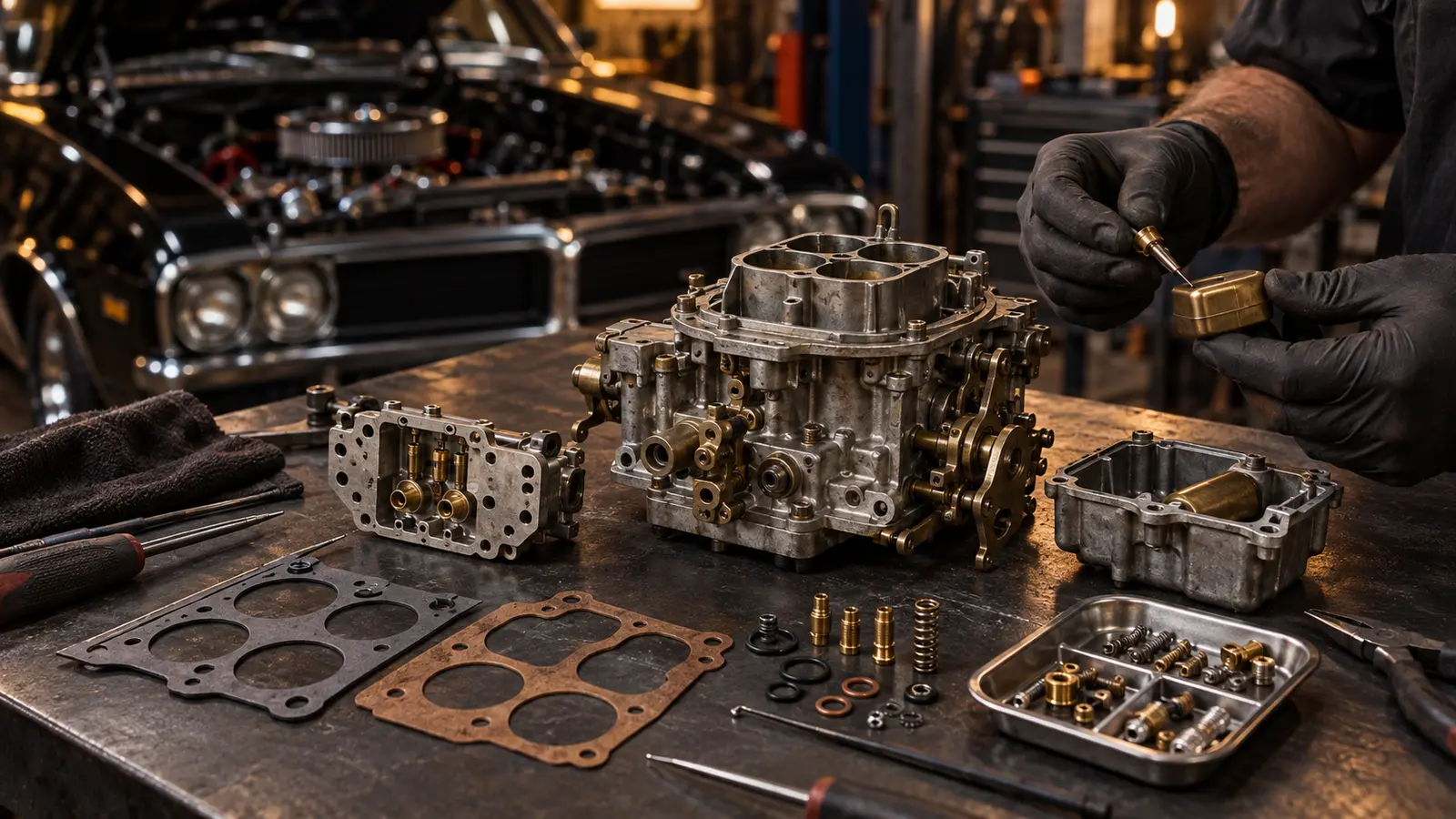
Carburetor repair · Fredericksburg + King George
Repair the fuel-metering problem before another adjustment creates a second one.
The search that brought you here
For owners searching for classic car carburetor repair, a carburetor rebuild, fuel-leak diagnosis, or help with a carbureted vintage car near Fredericksburg, King George, Stafford, or Spotsylvania, Virginia.
A carburetor that floods, leaks, sticks, will not hold a stable fuel level, or repeatedly falls out of adjustment may need more than tuning. At the same time, ignition faults, vacuum leaks, contaminated fuel, excessive fuel pressure, weak compression, heat soak, or incorrect linkage can imitate a failed carburetor. Ironwake approaches the complaint as a complete classic-engine drivability problem, identifies the carburetor and surrounding system, and defines repair or rebuild work only after the evidence supports it.
Tell us about the vehicle, truck, or boat →Record the carburetor manufacturer, model, list or part number, airflow rating, choke type, linkage, intake pattern, engine combination, and known modifications before choosing a kit or replacement component.
Check fuel supply, pressure, filtration, ignition, timing, vacuum integrity, engine condition, heat exposure, controls, and exhaust clues so a rebuild is not used to cover a fault elsewhere.
Clean and inspect repairable components, use compatible service parts, verify assemblies and settings, then make measured changes one circuit at a time with the final use of the car in mind.
What the project may include
The approved scope depends on the exact carburetor, engine, fuel system, condition, previous modifications, parts support, intended use, and whether the complaint can be reproduced safely. Some worn, corroded, cracked, warped, mismatched, or heavily modified assemblies may be better candidates for replacement than rebuilding.
A deliberate service sequence
A useful carburetor repair starts with identity and repeatable symptoms, not a generic kit and a can of cleaner. The sequence below separates conditions around the carburetor from faults inside it, protects small calibrated parts, and creates a baseline that can be tested after reassembly.
Record whether the issue appears during cold start, warm idle, hot restart, tip-in, cruise, braking, cornering, acceleration, or extended heat soak. Note fuel odor, visible wetness, smoke color, plug condition, backfire, hesitation, stalling, idle quality, recent repairs, storage history, and changes that make the symptom better or worse. A symptom tied to one operating condition narrows the test plan.
Locate the manufacturer identification, list or part number, model family, airflow rating when available, choke type, primary and secondary design, intake flange, fuel-inlet arrangement, linkage, and prior calibration changes. Document engine displacement, camshaft information when known, intake, ignition, fuel pump, transmission, gearing, intended fuel, and how the vehicle is driven before ordering service parts.
Inspect fuel age and contamination, tank venting, lines, filters, pump delivery, pressure against the exact carburetor specification, ignition condition, base and advance timing, charging voltage, vacuum leaks, PCV routing, compression or mechanical condition when indicated, throttle and kickdown linkage, return springs, and exhaust clues. A carburetor repair cannot correct an unstable foundation.
Check mounting torque and flange condition, external leakage, bowl level, choke release, float response where serviceable, accelerator-pump delivery, throttle movement, fast-idle hardware, vacuum fittings, shaft play, heat exposure, and evidence of overtightening or previous tool damage. Fuel leakage, binding, fire risk, or uncontrolled engine speed warrants shutdown rather than continued testing.
When rebuilding is supported, work from the correct manufacturer procedure on a clean organized surface. Preserve orientation, count and record existing settings where meaningful, keep calibrated pieces identified, inspect passages and sealing surfaces, and use cleaning methods compatible with the casting, coatings, nonremovable seals, floats, and small check components. Compressed air, solvents, and fuel-system work require appropriate protection and control.
Replace approved wear items and damaged service components with parts matched to the exact carburetor, then verify float integrity and settings, needle-and-seat operation, gasket alignment, diaphragm condition, accelerator-pump geometry, choke and secondary movement, fastener condition, throttle travel, and linkage return. Do not mix tuning changes into the rebuild before the original configuration and documented baseline have been evaluated.
Protect the intake during removal, use the correct flange arrangement, reconnect labeled vacuum and control systems, verify free throttle travel with the engine off, confirm filtration and specified fuel pressure, and inspect every connection for leakage before road operation. After warm-up, establish baseline idle and choke behavior, then test transition, cruise, hot restart, and load safely while changing one variable at a time and recording the result.
Local, appointment-based project work
Ironwake Customs is based in King George County and evaluates carbureted classic-car and classic-truck projects from Fredericksburg, Stafford, Spotsylvania, Dahlgren, Colonial Beach, the Northern Neck, and nearby Southern Maryland by appointment. For an initial project review, send the vehicle year, make and model; engine combination; carburetor manufacturer, model and list or part number; fuel and ignition setup; clear photos; recent work; storage history; when the problem occurs; and any parts already purchased. Inspection may still be required before a repair scope is established.
Check project fit ↗Useful planning references
These public, manufacturer, and industry resources add useful context for identification, system support, safety, and compliance. The exact vehicle and approved project scope still control the repair plan.
Manufacturer guidance for identification, careful disassembly, cleaning, stock-baseline reassembly, safe installation, leak checks, and making one measured tuning change at a time.
Open source ↗HolleyManufacturer references for locating list numbers, selecting parts, checking torque specifications, understanding float adjustment, and matching guidance to the exact carburetor.
Open source ↗U.S. Environmental Protection AgencyFederal compliance context to review before modifying emissions-related fuel, intake, control, or calibration equipment on a regulated vehicle or engine.
Open source ↗Questions owners ask before starting
Tuning changes calibration; rebuilding addresses contamination, deteriorated gaskets or diaphragms, sticking or leaking valves, damaged service parts, and other internal condition problems. Repeated flooding, external leakage, debris, dried components after storage, or settings that cannot remain stable can support a repair decision, but fuel pressure, ignition, vacuum leaks, engine condition, linkage, and heat should be checked first.
Common classic-car carburetor families can be evaluated, but serviceability depends on exact identification, condition, authenticity or previous modification, available specifications, and compatible service parts. Send clear photographs of every identification mark and the engine installation before assuming a kit or scope.
Possible causes include debris at the needle and seat, excessive fuel pressure, a damaged or saturated float, incorrect float setting, restricted bowl venting, heat-related expansion, damaged threads or fittings, or an installation problem. Shut the engine down, keep ignition sources away, and diagnose the fuel path before restarting the vehicle.
Only when an internal carburetor fault is the cause. Hard starting or hesitation can also involve choke operation, accelerator-pump delivery, ignition timing, weak spark, vacuum leakage, fuel supply, heat soak, compression, linkage, or a carburetor that does not match the engine. The repair should follow the diagnosis rather than replace it.
Replacement may be reasonable when the casting or baseplate is damaged, wear is beyond a practical service repair, components are mismatched or missing, reliable specifications or parts are unavailable, or the carburetor is wrong for the engine and intended use. Originality, serviceability, drivability goals, and the cost of correcting connected systems also matter.
Possibly. Existing jets, metering blocks, air bleeds, power valves, accelerator-pump parts, secondary components, linkage changes, drilled passages, removed choke parts, and mixed castings must be documented. Some changes can be returned to a known baseline; others may make replacement the more responsible path.
Send the vehicle year, make and model; engine displacement and modifications; carburetor manufacturer, model, list or part number and size when known; intake, ignition, fuel-pump and regulator information; photos of the installation and identification marks; symptom details cold and hot; recent work; storage history; and any kits or parts already purchased. Final pricing may require inspection.
The project needs a real starting point
Ironwake will review the vehicle, current condition, intended use, and requested scope before recommending the right next step.
Start the conversation ↗