Support the engine safely
A raised outboard can fall when pressure is released or a component fails. Diagnosis begins with the model-approved mechanical support and a work area clear of hands, tools, hoses, wiring, and people.
 IRONWAKECUSTOMS(202) 600-6906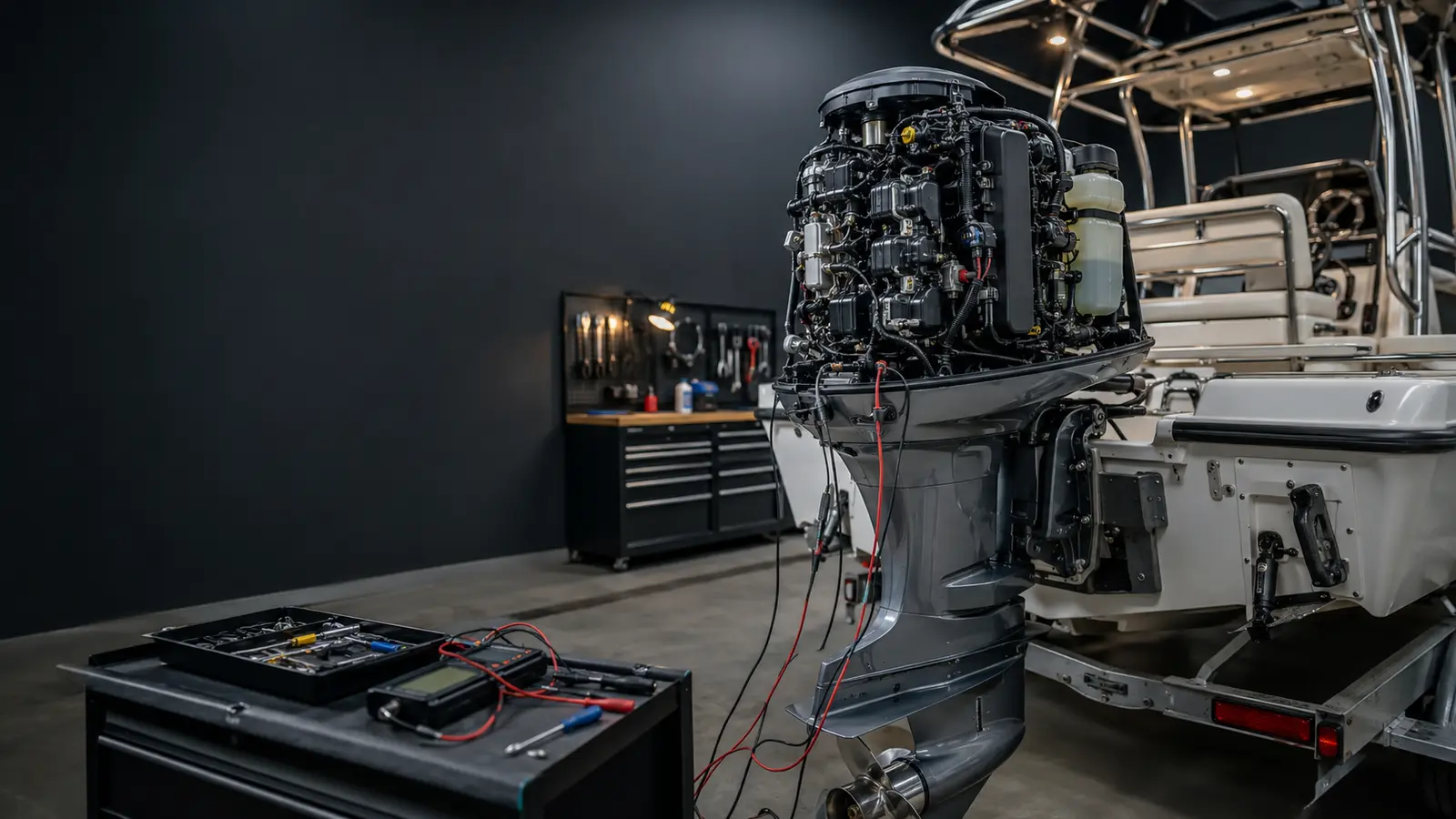
Outboard trim and tilt diagnosis · Colonial Beach region
Separate the electrical, hydraulic, and mechanical fault before the outboard gets stuck in the wrong position.
The search that brought you here
For boat owners searching for outboard power trim repair, trim-and-tilt diagnosis, a clicking trim relay, a trim motor that runs without lifting, drift-down repair, or help with an outboard stuck up or down near Colonial Beach, Dahlgren, King George, the Northern Neck, and nearby Southern Maryland.
A silent trim system, a single relay click, rapid clicking, a motor that runs without moving the engine, one-direction operation, jerky travel, visible fluid, weak lift under load, and an outboard that drifts down are not the same failure. They point toward different branches of the battery, switch, relay, wiring, motor, pump, valve, cylinder, fluid, bracket, and pivot system. Ironwake records the exact pattern, identifies the outboard and trim-unit family, secures the engine, and tests the supported branch before replacing parts or opening a pressurized hydraulic circuit.
Tell us about the vehicle, truck, or boat →A raised outboard can fall when pressure is released or a component fails. Diagnosis begins with the model-approved mechanical support and a work area clear of hands, tools, hoses, wiring, and people.
A click or open-circuit voltage does not prove that a cable, ground, relay, connector, or motor can carry current. Loaded voltage and voltage-drop tests keep the electrical diagnosis tied to real operation.
Fluid type, engine position, fill procedure, sealing surfaces, ram condition, and contamination control matter. The system is not opened or topped off by guesswork.
What the project may include
Project fit depends on the exact outboard and trim unit, manufacturer service information, corrosion, previous work, electrical and hydraulic condition, mounting integrity, parts support, and whether the engine or bracket is mechanically bound. Inspection determines whether the supported work is a focused switch, wiring, relay, motor, fluid, leak, valve, ram, or pivot repair—or whether additional specialist processes belong in the plan.
A deliberate service sequence
The sequence follows the evidence from safety and identification through control-circuit, high-current, hydraulic, and mechanical testing. Not every project requires every operation, and no pump, relay, motor, cylinder, or complete trim unit is condemned solely from a sound or a guess.
Use the model-approved mechanical support before anyone enters the bracket area. Record every switch result; silence, clicking, motor sound, direction, speed, engine angle, temperature, recent trailering, water exposure, drift rate, leaks, and whether the symptom occurs only under propulsion load. This first map prevents an unsafe or irrelevant test path.
Confirm make, model, serial or product identification, trim-unit family, battery arrangement, switch locations, specified fluid, recent electrical or hydraulic work, impact or grounding history, storage position, and any parts already installed. Similar outboards can use different wiring, relays, polarity, fluid checks, supports, and bleeding procedures.
Check battery condition and connections, required fuses or breakers, grounds, helm and cowl switches, harness routing, connectors, relay sockets, corrosion, chafe, heat damage, and previous repairs. If one switch works and another does not, that shared-system evidence narrows the failing control branch before high-current parts are disturbed.
Follow the manufacturer's diagram while measuring voltage at the motor and voltage drop through positive and ground paths during an UP or DOWN command. Compare relay paths and motor response without improvised unfused jumpers. A relay coil can click even when burned contacts, weak supply, resistance, or a failing motor prevents useful work.
With the engine secured in the specified position, inspect fluid condition and level, external seals, caps, lines, manifold, cylinders, ram rods, wipers, manual-release valve area, and evidence of contamination. Motor sound without lift, foamy or milky fluid, recurring oil film, weak lifting, or measured drift can direct further valve, pump, cylinder, or seal diagnosis without assuming the whole assembly needs replacement.
Inspect tilt tube, swivel and clamp brackets, trim pins, steering interaction, trailering support, pivot lubrication, corrosion, impact damage, marine growth, harness and hose tension, mounting hardware, and transom-area movement. A bind can overload sound electrical and hydraulic components. The estimate follows the supported fault and any safe access work; hidden damage and unavailable parts are not guessed in advance.
After approved work, use the specified fluid and manufacturer procedure to fill or bleed the system. Cycle only through the permitted range while watching current or voltage behavior, leaks, smoothness, noise, sender operation, cable and hose clearance, support engagement, and drift after rest. A protected water test may be needed to prove trim response under propulsion load without masking the original condition.
Local, appointment-based project work
Ironwake Customs is based in King George County and evaluates supported outboard power trim and tilt concerns for boat owners from Colonial Beach, Dahlgren, Fredericksburg, Stafford, Spotsylvania, the Northern Neck, and genuinely served nearby Southern Maryland by appointment. Potomac and brackish-water use can add corrosion, contaminated connectors, pitted ram surfaces, stiff pivots, sediment, seasonal storage, and trailering variables to the evidence. Send the boat and outboard identification, clear photos of the bracket and trim unit, switch-by-switch behavior, motor or relay sounds, leak and drift details, battery information, service history, recent impact or grounding history, and any previous test results.
Check project fit ↗Useful planning references
These public, manufacturer, and industry resources add useful context for identification, system support, safety, and compliance. The exact vehicle and approved project scope still control the repair plan.
Yamaha's manufacturer video provides model-aware context for power trim and tilt inspection, care, support, fluid, and maintenance decisions.
Open source ↗American Boat & Yacht CouncilABYC maintains the principal voluntary safety standards used across recreational-boat electrical, systems, and service work; the exact applicable standard and manufacturer procedure still control the project.
Open source ↗U.S. Coast Guard Boating Safety DivisionThe Coast Guard index connects owners to federal recreational-boating requirements covering boats, associated equipment, electrical systems, safe powering, and hazardous-condition responsibilities.
Open source ↗Questions owners ask before starting
A click usually means a relay coil received a command, but it does not prove the battery, cables, grounds, relay contacts, motor, pump, hydraulic circuit, or pivots can do useful work. Loaded voltage, voltage-drop, motor-response, fluid, and binding tests separate those branches.
Possible causes include low or contaminated fluid, trapped air, an incorrectly seated manual-release valve, pump or valve trouble, cylinder-seal bypass, external leakage, an overloaded engine position, or a mechanical bind. Secure the engine and follow the exact model procedure before opening the system.
Many systems use separate relay paths and reverse motor polarity for UP and DOWN. A switch branch, wiring connection, relay, socket, motor lead, limit or control input, hydraulic valve, or angle-related bind can affect one direction. Compare the supported circuits instead of swapping parts at random.
Drift-down can come from an external leak, air, a manual-release valve that does not seal, internal valve leakage, or cylinder-seal bypass. Clean and dry the unit, secure the engine mechanically, document the rate, and test the source. Do not rely on drifting hydraulics to support the engine during service, storage, or transport.
No. Use only the fluid specified for the exact outboard and trim unit, and check or fill it only in the required engine position. Mixing fluids, introducing dirt or water, or filling at the wrong angle can create contamination, overflow, seal trouble, or an incorrect operating level.
Not automatically. Ram condition, corrosion or scoring, seal location, fluid contamination, cylinder condition, internal bypass, parts support, access, and related bracket damage determine the repair boundary. Inspection is needed before deciding whether a focused repair, broader service, or another specialist process is appropriate.
Send the boat and outboard make, model, serial or product identification; trim-unit identification when visible; battery setup; photos of the full bracket, rams, motor, pump, wiring, relays, switches, leaks and corrosion; behavior from every switch; motor or clicking sounds; drift rate; fluid observations; recent impact, trailering or service history; and parts already purchased. Inspection may still be required before pricing.
The project needs a real starting point
Ironwake will review the vehicle, current condition, intended use, and requested scope before recommending the right next step.
Start the conversation ↗